
HOLY STITCH!
Factory Fellowship
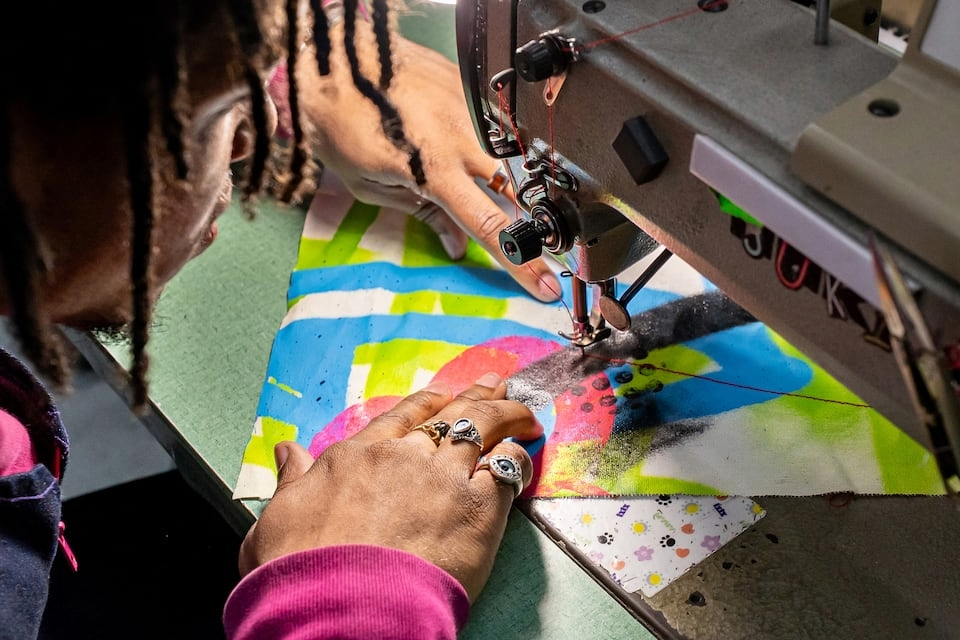
Holy Stitch! Factory Fellowship is a San Francisco 501(c)(3) training program inside a working denim factory at 1059 Market Street. Fellows learn to cut, sew, and finish garments through supervised training projects; paid staff and apprentices fulfill customer orders. Twenty people have been placed in paid work: six with outside employers, two hired full-time here, and 12 in part-time paid work. College progression is tracked separately and may overlap with these outcomes.
We are working with the California Division of Apprenticeship Standards to accredit the apprenticeship, which would make this training a registered, portable credential.
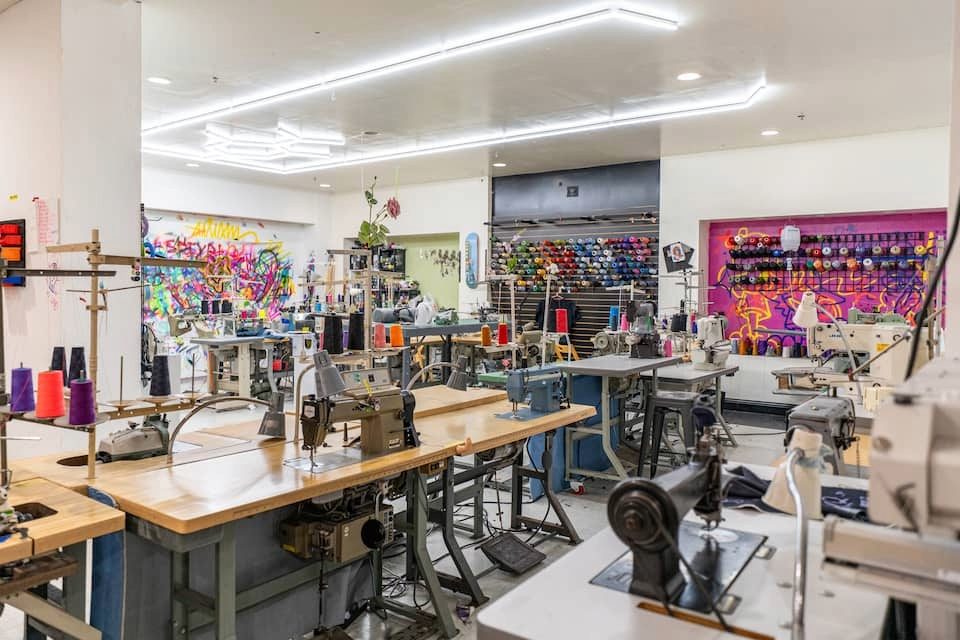
Young people in San Francisco are lonelier, sadder and more locked out of paid work than they have ever been. In San Francisco, a full-time minimum-wage job still falls about $23,000 short of a living wage. The factory answers all three at once: a room where you belong, work your hands can see, and a trade that pays.
Crafting is linked to wellbeing, but on its own it is not linked to lower anxiety or loneliness. The room does that, which is why the program is both: the craft gives calm, focus and purpose, and the floor gives the people. The 43% figure comes from an eight-week summer jobs trial, not from HSFF. We have not measured our own crime outcomes; what the research proves is the mechanism, paid work plus a mentor.
Going forward, each Fellow will complete a short check at entry and exit: three questions on connection (UCLA 3-item scale), five on wellbeing (WHO-5), and our skills checklist, followed by 30- and 90-day follow-up on earnings, jobs, apprenticeships and further training. That sits alongside the counts we already track: 32 young people served in 12 months, annual capacity for up to 42 fellowship seats, 2 paid apprentices today (4 total at the $125,000 milestone, 6 total at the $250,000 goal), and $8,153 per fellow per year.
Sources: U.S. Surgeon General, Our Epidemic of Loneliness and Isolation (2023); WHO Commission on Social Connection (2025); CDC Youth Risk Behavior Survey (2023); Kaimal et al., Drexel University (2016); Keyes et al., Frontiers in Public Health (2024); Measure of America; Deloitte and The Manufacturing Institute, 2024 Talent Study; Heller, Science (2014) and Heller, Pollack & Davis (2017); Belfield, Levin & Rosen (2012) and Aspen Institute Opportunity Youth Forum (2026); Bureau of Labor Statistics via Challenger, Gray & Christmas (2026); Kuehn et al., U.S. Department of Labor (2022); UNEP, Ellen MacArthur Foundation and WRAP; Civic Economics / American Independent Business Alliance; U.S. Census 1970 and 2020; SF Adult Education Consortium (2025). HSFF figures from the September 2026 program summary.
That figure covers instruction, materials, machine time and floor supervision. It does not include the facility, which is carried separately and is the subject of our current campaign.
Our IRS determination letter, articles of incorporation, bylaws and financial filings are available on request while we prepare them for posting here. We send them the same week.
Request documents: info@holystitch.org →Roughly 39% of our 2025 nonprofit revenue came from two sources: event-based program revenue and a single grant. That concentration is a real risk and we are addressing it by building a base of individual donors.
Our occupancy has been subsidized. Over 36 months the Mid-Market Business Association & Foundation contributed $180,000 in donated occupancy against a contractual $6,000 a month. That subsidy ends on 31 December 2026, which raises our facility cost by $4,500 a month, or $54,000 a year. It cannot be renewed because of federal and state funding cuts. This is the gap our current campaign closes.
You do not have to take our word for any of this.
Six directors from apparel manufacturing, design education, and Bay Area arts and civic infrastructure. The board serves on a volunteer basis. No board member is compensated by the organization.
Apparel educator focused on responsible fashion and the value of clothing. Her teaching and research connect sustainable production, product reuse and community learning, alongside industry experience in apparel development and production.
Began his garment career at Levi Strauss's Valencia Street factory in San Francisco and later became a senior patternmaker for Dockers. His work spans denim development, custom fit, patternmaking and made-to-measure production.
Educator and consultant in garment manufacturing with more than 35 years across sourcing, product development, production, operations and supply chains. She helps emerging and established brands turn ideas into workable, responsible production plans.
Leads CAST, which works to secure lasting space for arts and cultural organizations. He has led organizations across arts, media and public-interest infrastructure, with experience in nonprofit finance, partnerships and organizational growth.
An apparel entrepreneur working in independent clothing and custom screen printing in Oakland. He brings a maker's perspective to building products, businesses and creative communities.
Artist and curator whose work brings art, fashion, music and community into conversation, with a focus on making space for emerging and overlooked artists. A longtime part of the Tenderloin and Mid-Market creative community.
For governance questions, our determination letter or our most recent filing: info@holystitch.org
Gifts go to the Fellowship's education and workforce programs, paid apprenticeships, and the nonprofit's allocated share of the facility.
Form not loading? Give securely on Givebutter →
$157 covers approximately one week of training for one fellow; $8,153 covers a year, excluding facility costs. Made on Market's first ask is $80,000 by December 31, 2026, to support a training floor with capacity for up to 42 fellowship seats a year. At $125,000, the goal is four total paid apprenticeships, up from two today. The full $250,000 campaign runs through December 2027 and aims to support six total paid apprenticeships, dedicated instruction, equipment, materials and additional cohorts.
Holy Stitch! Factory Fellowship · 1059 Market Street, San Francisco, CA 94103 · info@holystitch.org · 415-378-5378
1059 Market Street
San Francisco, CA 94103
Tue–Fri 12–6pm · Sat–Sun by appointment